025 Is the Effort Required for Optimal Health Worth it?

Navy SEALs are perhaps some of the most well-trained and respected warriors on the planet. To attain such a status SEALs begin at Basic Underwater Demolition/SEALs Training (BUDS), a rigorous physical, mental, intellectual, and spiritual 24-week program designed to push hopefuls to their limits and make them quit.

90% do.

What about the 10% who stick it out? How do they endure BUDS and complete their training to become SEALs?

Former Navy Seal Lieutenant Commander now highly-acclaimed author Jocko Willink is famous for teaching, “There’s no growth in the comfort zone.”

He and other SEALs when remembering BUDS state it never occurred to them to quit. Quitting was not an option because they knew being a SEAL was what they wanted so they found a way.

While most of us will never experience the same challenges as Navy SEALs we all encounter times when we feel like giving up, including when it comes to our health.

Author Seth Goden writes, “Short-term pain has more impact on most people than long-term benefits do, which is why it’s so important for you to amplify the long-term benefits of not quitting.” (The Dip, 53.)

In the 1992 film, A League of Their Own, baseball coach Jimmy Dugan (played by Tom Hanks) emphasizes, ”It’s supposed to be hard. If it wasn’t hard, everyone would do it. The hard is what makes it great.” The same can be said for caring for your health.

Goden continues, “Never quit something with great long-term potential just because you can’t deal with the stress of the moment.” (The Dip, 64.)

So it seems the question is not, “Should I continue to learn and try new approaches to improve my health?,” rather, “Is it worth it?”

If your answer is “no” then stop reading this blog. You’re wasting your time. I don’t hate you. I respect your intentionality and perhaps later you’ll feel differently. For the rest, having and attaining the best health you are capable of is of upmost importance to you, your children, spouse, other family members, friends, and the world because your body in good health is the vehicle that’s going to allow you to do the work you were put on this earth to do.

You can do it. You can thrive. You can turn the key to better health, no matter where you are or where you’ve been. Do it one small step at a time, one new habit at a time. Though applied to a different situation the principle is also true of your health, “it’s never too early and it’s never too late.”1

1 https://www.churchofjesuschrist.org/study/general-conference/2015/10/its-never-too-early-and-its-never-too-late?lang=eng

024 Poor Health is Reversible; So is Good Health—Do the Former

Three years ago I began to have pain in my thumb joints. I noticed the pain more when texting. I experimented to determine if thumb-texting was the cause by texting with a different finger. It worked. The pain went away.

On another occasion my lower back chronically ached as I drove in traffic daily to and from work. A doctor looked at it and prescribed physical therapy. After a few weeks of therapy I began to feel better. One particular lower back strengthening exercise (which I still do) made (makes) the pain go away. Physical therapy changes lives.

I realize not every illness can be reversed but many can. Decide what’s within your control and do that thing. It can change your life.

It seems our bodies are incredible self-healers if we do not impede, rather promote it.

Anyone who’s watched the documentary Supersize Me understands an otherwise healthy person’s baseline deteriorates with consistent health withdrawals.

Invest today in yourself. You can do it. You’re worth it. #breathesleepdrinkeatmovelearnintentionally

023 Form A Simple, Healthy Water-drinking Habit

A brother was a college soccer captain. With a desire to optimize his performance he prioritized hydration. While roommates I observed him drink water before he went to sleep and when he awoke.

I tried it.

That was over 15 years ago.

I still do it.

While at a Toastmasters meeting about the same time period, I listened to a woman’s speech entitled, “How Good Can I Feel?!” She shared the benefits of drinking a glass of water before bed and a glass of water when arising.

Of course these aren’t the only times you should drink water; you should drink water throughout the day and yet I’ve found this daily practice to the beginning and end of the day are effective reminders.

Implementation tip:

Keep a cup or water bottle by the bathroom sink. That way it reminds and enables you to drink before bed and when waking up.

022 Serving sizes and finishing them

For Baby Boomers it was not uncommon for parents to encourage or insist that children eat everything on their plates.

Not wasting food and money is a good thing however this approach to eating becomes harmful when it leads to overeating because

Consistent Overeating + Time = (Preventable) Disease.

The good news

You can both eliminate waste and have abundant health if you do this:

Start with less.

Let me explain.

For two years as a missionary in Brazil most days families from church fed us lunch. Often these people were poor, sometimes very poor. We were taught to take a little bit at first to ensure everybody got some and then if there was more to go around (which they’re usually was) and the host invited us we would have a second (or third) helping.

When you start with a small portion:

  1. You show respect to your host (greater chance of being invited back). If it’s a home meal, you show love and respect to the other members around your table
  2. You eliminate (or at least minimize) waste
  3. You’re free to try new things
  4. You’re free to fill up on what you like!

Starting today, be intentional about the portion of food you start with. Begin with a little bit and then add more.

Bonus benefit

It slows down eating, giving your body more time to process and signal to you when your feel full

021 Breathe Intentionally

In his book Breath, James Nestor shares his experiences dealing with respiratory health challenges—allergies, sinus infections, sleep apnea, you get the idea—and the people he met and the actions he took to improve his situation over 10 years.

*Key Takeaways

  • Close your mouth, breathe through your nose. Most breathing should be nose breathing. It’s how our bodies were designed.
  • Regularly breathe 5 1/2 second in, 5 1/2 seconds out
  • When you feel anxious, use “box breathing”— breathe in for four seconds, hold for four, exhale for four, hold for four. Repeat. Navy Seals use this technique to relax in highly stressful situations.

#breatheintentionally

* Consult your physician or a healthcare professional before starting an exercise or breathing program.

019 Eat More, Feel Full, and Live Longer

Not long ago my wife and I began cooking dinner meals together— Chinese chicken salad Hawaiian haystacks, split pea soup, lettuce wraps, and today, sweet-and-sour chicken…

No doubt you have delicious recipes, traditional and comfort food of your own you regularly enjoy.

Jules designed these recipes to taste good, be inexpensive, and be easy to prepare. After delighting in our culinary creation one evening, she remarked how full she felt! Interestingly, the meal contained a fraction the calories of a McDonald’s Big Mac. (See 018 Eat for Weight.)

Dr. William Li, author of award-winning book Eat to Beat Disease, writes,

“Beyond the types of foods that we consume, another way in which food is connected to longevity is by the amount in which we consume it. It is now a well-known fact in the science community that reducing the intake of calories by 20-40 percent can increase longevity and reduce the risk of chronic diseases.
“Some people hear caloric restriction and immediately think of starvation or a fad diet. But that is not the case. Caloric restriction is a condition that has been experienced throughout human evolution and our metabolism has learned to function extraordinarily well under these conditions. Researchers at the Massachusetts Institute of Technology have determined that restricting calories activates stem cells in the intestines, which regenerate cells in the gut.” (Boldface and italics added.)

In other words, eating fewer calories increases health and adds years to your life. And there are fewer calories in whole, simple, unprocessed foods, The cool part is, by cooking foods at home you can eat more, consume fewer calories, feel full, and live longer.

Eat intentionally.

Bon apetite.

020 Showing Up

I work with a group of outstanding young men. I invited them for one week to read one scripture every day. Some did. Others did not. The purpose of the challenge was not to develop deep, spiritual roots; such only comes from consistent concentrated study over time. Rather, this invitation’s purpose was for them to start to build a foundation of regular scripture study.

Studying the scriptures may not be of interest to you now but if you’re reading this likely you are interested in improvement. You want to better yourself and reach your full potential.

Realizing your full potential comes from developing the habit of SHOWING UP for the right things. Do it consistently over time and you’ll be amazed at the results.

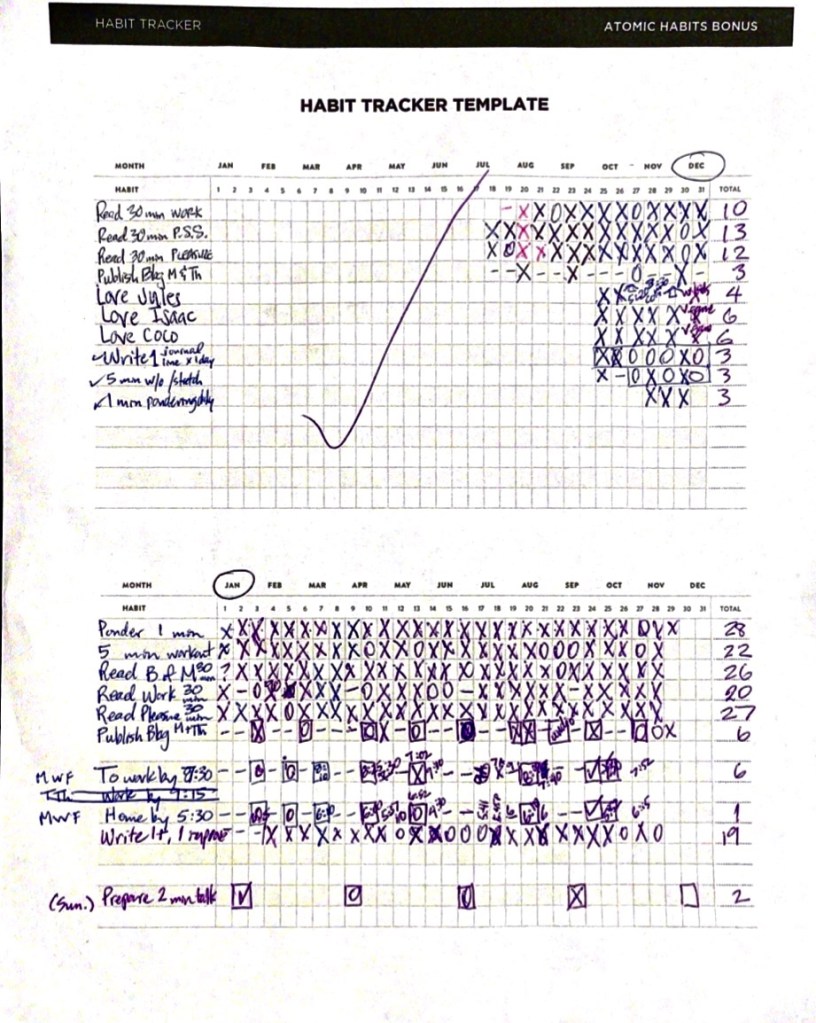
Here’s the pattern when forming a new habit: 1. Write the new habit on a habit tracker(1), 2. Make it easy, 3. Show up (do it consistently), 4. Record your progress immediately after completed, 5. Celebrate your success with a signal or yell that gives you “shine” (as B.J. Fogg terms it). As for me I yell “Victory!” while throwing a sideways “V” symbol with my right hand.

Commenting on parts 4 and 5 of this pattern James Clear writes, “People often think it’s weird to get hyped about reading one page or meditating for one minute or making one sales call. But the point is not to do one thing. The point is to master the habit of showing up. The truth is, a habit must be established before it can be improved. If you can’t learn the basic skill of showing up, then you have little hope of mastering the finer details. Instead of trying to engineer a perfect habit from the start, do the easy thing on a more consistent basis. You have to standardize before you can optimize.” (Atomic Habits.)

Be intentional.

(1) Learn more about the Habit Tracker at https://jamesclear.com/habit-tracker. (No, I do not get paid by James Clear).

018 Eat for Weight

November 2002,
Manaus, Brazil

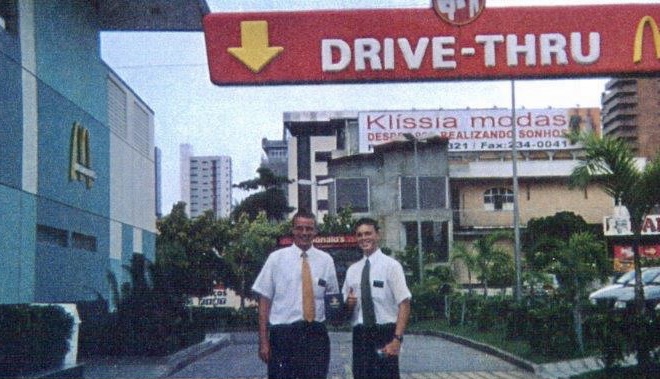
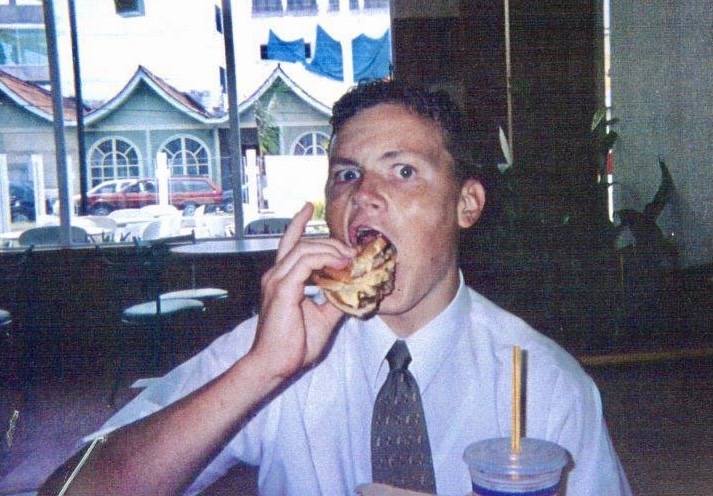
It was Thanksgiving in Manaus, Brazil. No one else around me cared except my missionary companion. It was my first Thanksgiving outside the United States and as patriotic Americans and finding ourselves sans the usual turkey, mashed potatoes , and gravy Elder Donat and I decided we’d feast with the closest thing—McDonald’s.

Big Mac—so good but not very filling.

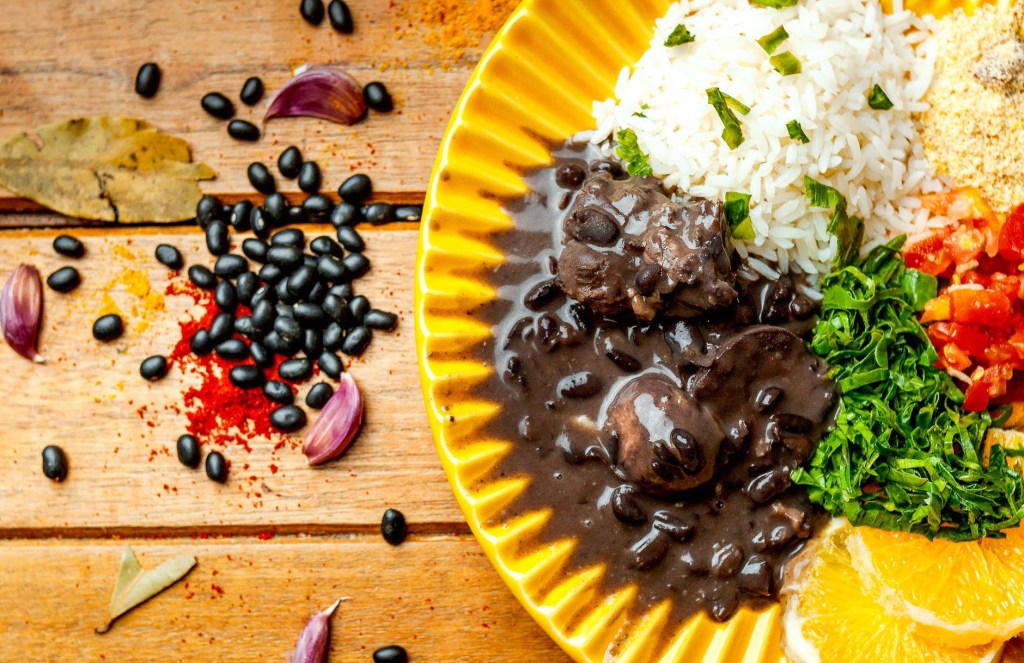
For a 19-year-old young man now accustomed to the local rice and beans fare, 2 Big Macs left me feeling the opposite of every other Thanksgiving before this—empty.1

Why?

One study suggests drinking water before a meal increases satiety.2 Researchers in the experiment tested whether drinking water before a meal resulted in participants eating more or less of the meal. Participants who drank water before the meal in the experiment ate less.

The same may be true when we consume water-rich foods—if not rice and beans, whole grains, fruits and vegetables, low-fat dairy, lean meats. Try it for yourself.

#eatintentionally

1. Perhaps that’s why they’re called “empty” calories.

2. Jeong JN. Effect of Pre-meal Water Consumption on Energy Intake and Satiety in Non-obese Young Adults. Clin Nutr Res. 2018 Oct;7(4):291-296. doi: 10.7762/cnr.2018.7.4.291. Epub 2018 Oct 31. PMID: 30406058; PMCID: PMC6209729.

017 “Bliss Point” and Intentional Eating

Salt, sugar, fat…much food today is engineered using these three levers for a “bliss point” or “the right amount of ingredients to generate the greatest appeal among consumers”1.

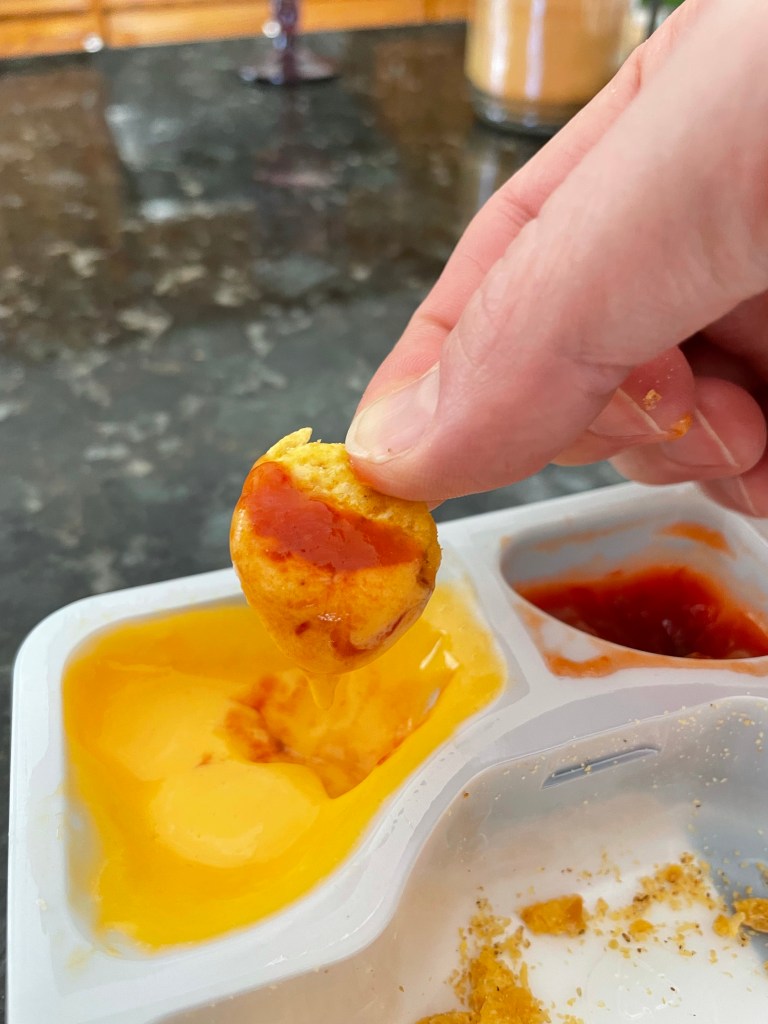
One such food is the Lunchable chips, salsa and cheese. SO GOOD!

Combining these three in one mouth makes tastebuds sing!

Where’s the balance? Is there a time and place for foods like these?

Ecclesiastes 3:1 in the Bible (also made famous by the Beatles) reads, “To every thing there is a season, and a time to every purpose under the heaven”.

For me, I’ve found success in eating by making a place for every delicious food in my life—I’ve just adjusted the quantities and frequencies of consumption.

As my wise sister Nicole once observed, “Abstinence breeds indulgence.” So…if you love ice cream, eat it because if you totally cut it out of your life eventually you crack and overdo it. Further, ice cream is part of the joy and pleasure of living. Just adjust how much and how often.

Tips

1. Prepare and eat a meal with all the food groups before eating dessert or snack foods. Keep the main thing (meal) the main thing.

2. Add other filling, delicious, (in some cases nutritious too, added bonus) food items to your treat. For example, include banana slices, strawberries, 1% milk, and/or sprinkled nuts or peanut butter to your favorite cup of ice cream. Whoa!!

3. Drink water with meals. Some studies conclude our bodies feel full based on weight rather than calories. (Why a bowl of soup can be so filling or a “heavy” rice and beans meal is more filling than 2 Big Macs. More on this later.)

You got this. Go eat intentionally today.

1. Moss, Michael. Salt, Sugar, Fat. 28.

016 More about Goldilocks…Don’t Be A Hero

As a varsity high school athlete my beliefs about effort on the field and during practice workouts shaped my fitness habits as an adult. “Leave it all on the field,” “Give 110%…”. You’ve heard the phrases. Was this your experience as well? I’m not saying these are incorrect or demotivating. They had there place and time. I learned about pushing the limits on mental and physical toughness. I learned that I could endure pain beyond what I thought I could and achieve more then I thought possible. These are lessons I carry with me and will never forget.

I AM saying that to be fit and healthy, you don’t have to go all out, all the time, or even at all. It depends on your goals.

For example, if you want to qualify for the Boston Marathon, then yes, it’s gonna be tough. It will not only require your time and physical strength but also your heart, sacrifice, and plenty of emotional energy.

If conversely however you desire to ascend a flight of stairs without breathing heavily, to have low cholesterol, and be able to play with your kids or grandkids your plan will be different.

It does not take Navy Seal-like training to be healthy yet it still will require effort and intentionality.

Be consistent and as James Clear puts it, “make it small”.

Change the wording in your mind, from, “I have to go to the gym,” to “I can go if I choose to”. When you choose to go, tell yourself you can choose to workout as little or as long as you want. Only do one exercise if that is your Goldilocks Rule (not too hard, not too easy, just right. For more on this rule see 014). This mindset will promote consistency and consistency will lead to habit—the healthy habit you set out for initially.

Let me explain.

At the beginning of my senior year of college I set a goal to run a five minute mile. I’d run in the 5:45 range before so this was far faster than I ever had run before. Training was intense – 30 to 50 mile weeks at varying speeds and distances. I did speed workouts on the track, 7-10 mile runs, bleacher and calisthenic training, and weights.

I felt encouraged as I saw my time drop from 6:30, to 6 minutes, to under 6, to 5:32…with the help of training buddies I peaked at 5:11 before calling it good.

After my final attempt I spoke with my friend Jared (the runner who paced me to 5:11). I told him I was done with this goal. Jared acknowledged and encouraged me to continue to run, not the grueling 50 miles a week but perhaps one or two. And so I have.

That was over 12 years ago.

It’s far better to do something than nothing. Great things proceed from small ones. A habit started at this level is on track to stick.